

Commentary
Michael Young
{
  "authors": [
    "Michael Young"
  ],
  "type": "commentary",
  "blog": "Diwan",
  "centerAffiliationAll": "",
  "centers": [
    "Carnegie Endowment for International Peace",
    "Malcolm H. Kerr Carnegie Middle East Center"
  ],
  "englishNewsletterAll": "",
  "nonEnglishNewsletterAll": "",
  "primaryCenter": "Malcolm H. Kerr Carnegie Middle East Center",
  "programAffiliation": "",
  "regions": [
    "Iran",
    "United States",
    "Israel",
    "Gulf"
  ],
  "topics": [
    "Nuclear Policy"
  ]
}
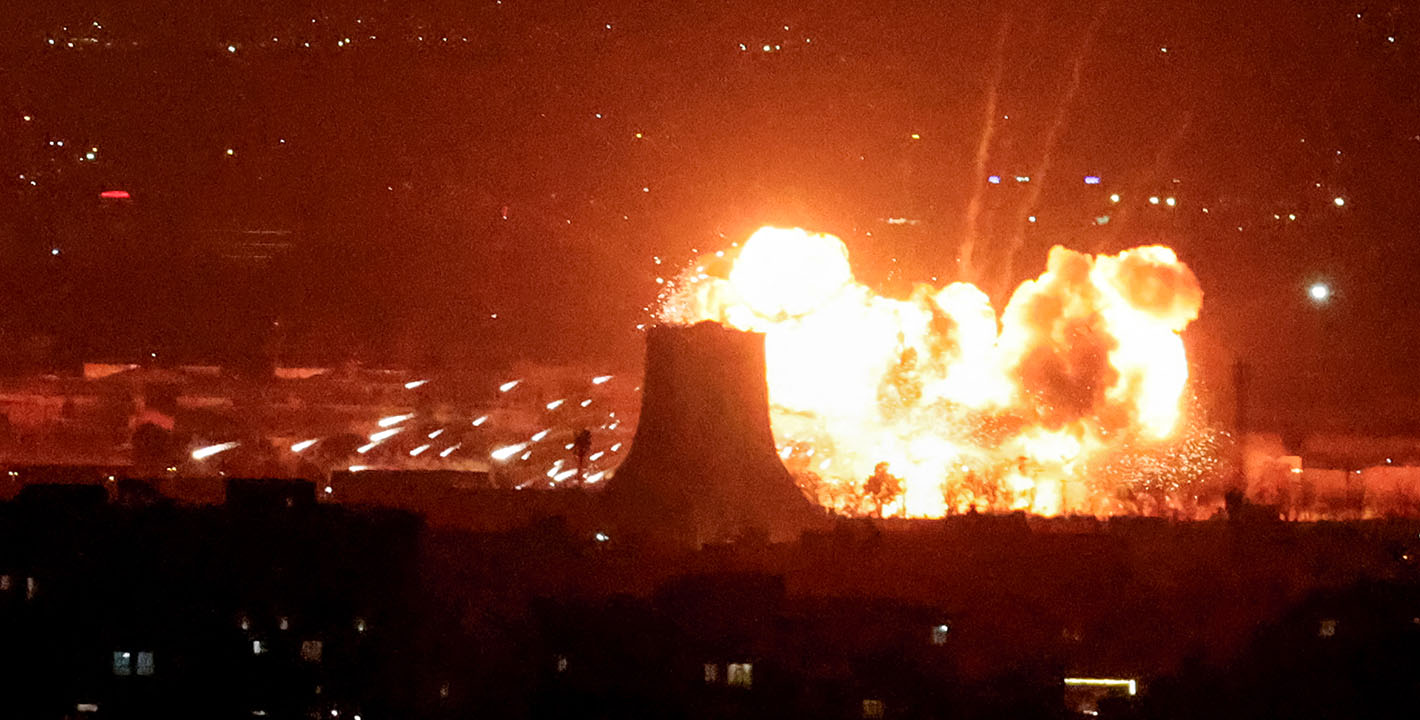
Source: Getty
In an interview, Marc Lynch discusses his new book decrying the post-1990 U.S.-dominated order in the Middle East.
Marc Lynch is a professor of political science and international affairs at George Washington University in Washington, D.C., and the founding director of the Project on Middle East Political Science. Previously, he was a nonresident senior fellow at the Carnegie Endowment for International Peace. Lynch is the author of, among other books, The New Arab Wars: Uprisings and Anarchy in the Middle East (Public Affairs, 2016) and The Arab Uprising: The Unfinished Revolutions of the New Middle East (Public Affairs, 2012). He also runs the Abu Aardvark blog and the Middle East Political Science podcast. His most recent book, America’s Middle East: The Ruination of a Region (Oxford University Press, 2025), is a powerful indictment of the post-Cold War U.S.-dominated order in the Middle East, and it is to discuss this book that Diwan interviewed Lynch in mid-May.
Michael Young: In an exchange with me prior to the interview, you described the experience of writing this book as “cathartic.” Can you explain why?
Marc Lynch: Like most people, I watched Israel’s devastation of Gaza with increasing horror and outrage. It was clear fairly early on what was going to happen. I warned in a piece for Foreign Affairs before Israel’s ground invasion that it would become exactly the catastrophe that it turned out to be. As the evidence mounted of the civilian harm and infrastructural destruction Israel was inflicting on Gaza, and the absence of any plausible endgame beyond its complete obliteration, I was just appalled by the Biden administration’s refusal to use its leverage to get Israel to comply with the most basic laws of war and human rights standards.
And even more shockingly, virtually nobody resigned in protest. I don’t much care about whether we call it a genocide or not—let the lawyers argue about that. It was extremely clear that Israel’s war on Gaza amounted to major war crimes, mass civilian deaths, and suffering, and the near total destruction of Gaza as a place capable of sustaining human life. The United States was the only actor that could have stopped it, and Joe Biden chose not to.
But when I sat down to write a book about Gaza, my excellent editor suggested that I think bigger. And he was right. In some ways it would be easy if Gaza were an exception, something horrible but ultimately different from any other issue. But it’s not. I began my career working not on Israel-Palestine issues, but on Iraq, and specifically on the sanctions. And I remember feeling that same sense of outrage at the ease with which U.S. officials and think tankers dismissed the reality or the significance of the suffering they were imposing on the Iraqi people while claiming to champion them. I came to see a straight line from the indifference to the humanity of Iraqis in the 1990s to the absolutely horrifying support for Israel in Gaza. So, I sat down to write a book that would assess the entire period of American primacy in the Middle East—the period after 1990 when it experienced unchallenged domination with no real peer competitors. What did we do with our power? And the reality is that U.S. policy largely succeeded during that period in achieving the core objectives the United States had defined for itself: keeping Israel secure, keeping the oil flowing, and preventing any internal or external adversary from disrupting the system from which it benefited. But this came at the expense of virtually everybody who lived in the region, whose lives for the most part became infinitely worse under this American order.
We like to think in Washington that we are the only thing standing between the region as it is and something even worse. I used to write policy reports and opinion articles trying to make things a bit better. But I think at some point after 35 years, we should acknowledge that we bear considerable responsibility for the sad state of the region. So, the catharsis I suppose came from stepping back and taking an honest look not just at one policy gone wrong, but at an entire structure built to sustain domination and the immiseration of the region. And it’s really striking if you think about it: For the most part, everyone knows this. They just choose to not take the kinds of actions that might change it.
MY: One of your main arguments is that the U.S. order in the Middle East almost naturally leads to the region’s ruination. Can you explain your reasoning?
ML: Part of it is simply that primacy is generally bad. You remember Lord Acton’s saying, to the effect that power corrupts and absolute power corrupts absolutely? I think that applies in the Middle East—to the United States and Israel alike. They are accustomed to acting with impunity, standing outside the rules and demanding that their self-interest take priority over anything else. And what that means is that even if Palestinian, Syrian, Iraqi, or Lebanese suffering is sad, it’s not important enough to them to warrant changing policies. It really only matters if it can be weaponized to justify action against an adversary; if our friends do it, we look the other way. And in the absence of real external costs or peer competitors forcing policy change, our policy tends to be locked in place in ways that are not responsive to what’s happening on the ground.
My book is in large part about the triumph of structure over agency, in political science terms. Every single American president since Bill Clinton has come into office promising to change U.S. policy and draw down from the region, and every one of them has ultimately been drawn back into the same set of unpleasant policies. However they start, they all end up ignoring democracy and human rights, promoting Arab normalization with Israel while ignoring Palestinian rights, putting pressure on Iran, and waging wars on terror. And that’s partly because they work in terms of protecting self-defined interests. Think about Biden officials arguing that their policy in Gaza was a success because we supported an ally, didn’t lose any Arab allies, and didn’t allow China to make any inroads. That’s all true on its own terms, but it completely ignores the almost unthinkable human costs and the degradation of international order.
Structure here isn’t as abstract as it sounds. Our policy is locked into place at the domestic level by a whole array of lobbies working to make sure that it remains that way—not just the American Israel Public Affairs Committee, but also wealthy Gulf states, the oil and arms industries, elite networks who profit enormously from the status quo. It’s also sustained by a certain orthodoxy within think tanks (many of them dependent on Gulf funding) and media commentary, a public discourse which violently attempts to suppress ideas that challenge our policy, as we’ve seen with the crackdown on the campus protests against the war in Gaza. An underappreciated part of the structure is the leaders of the states in the region who have long seen their survival as dependent on a continuation of America’s Middle East. They have prioritized remaining in power at any cost and done Washington’s bidding in exchange, and have gotten very anxious when Washington doesn’t hold up its end of the bargain—whether Barack Obama accepting Egyptian president Hosni Mubarak’s overthrow in 2011 or Donald Trump’s launching this disastrous war against Iran, exposing them to an existential threat.
Arab leaders don’t need to be told to prevent democracy or contain Iran, they do it for their own reasons. In fact, as they have evolved and adapted to the American order, they’ve become the key obstacle to change. Think about how every U.S. ally in the Middle East worked to frustrate every one of Obama’s priorities, from the Joint Comprehensive Plan of Action, the nuclear deal with Iran, to democratization after the Arab uprisings. The U.S. cooperates closely with Israel and supports it to the hilt, even when Israeli actions directly and negatively impact American interests—think about its recent interventions in Syria, which undermined U.S. efforts to stabilize the country under its interim president, Ahmed al-Sharaa, or its bombing campaigns against Lebanon in the face of U.S. efforts to secure a regional ceasefire. And, of course, its long defiance of ostensible U.S. support for a two-state solution by escalating settlement building in the West Bank, and so on, all without meaningful consequences. Regional actors are often truer custodians of America’s Middle East than whoever occupies the White House—they benefit from the system as it is, and they work to keep it that way.
My book concludes, in line with Edward Said’s long-ago observation, that every empire thinks that it’s different. In Washington, we can’t imagine a Middle East that isn’t American any more than the British or French could envision an end to their domains. But those empires ended, and America’s will too. And when it does, it will pass alone, unmourned and unloved. I thought Gaza would be our Suez moment, but now Iran and the closing of the Strait of Hormuz will likely be what history remembers. We are seeing this unfolding right now, as Iran has systematically destroyed most of the U.S. basing architecture in the Gulf and exposed the limits of American power in genuinely transformational ways. A transition to a post-American Middle East is going to be messy and violent, as we are seeing, but it’s inevitable.
MY: I think it’s fair to describe you as a foreign policy realist. While realists do concern themselves with such issues as repression and the absence of democracy in terms of how this might affect the behavior of states, these are not generally viewed as an essential focus of realist thinking. In your case, however, I noticed you made it a central tenet of your argument on the U.S. order in the Middle East, sounding almost Wilsonian in places. Can you explain why?
ML: I didn’t used to be a foreign policy realist. Most of my academic career was spent as a constructivist—which means taking seriously the role of ideas, norms, values, and discourse. I’ve always prioritized the close study of Arab public opinion and the broader public sphere, and tried to make Washington take it seriously. Even if Arab leaders didn’t really take their rhetoric very seriously, and had no intention of sacrificing their self-interest to Palestine, we needed to understand the terms on which they played their own political games, both domestically and in regional politics. The question of whether Saudi Arabia would join the Abraham Accords was a great example of all of this. Crown Prince Mohammed bin Salman might have very much wanted to normalize with Israel if he had gotten the right deal from Biden or Trump, but he had to carefully monitor his domestic situation and the regional game. I think that both Biden and Trump focused so much on their relationships with autocratic leaders, and were so cynical about the so-called “Arab street,” that they really misunderstood what was going on.
So, I still think that ideas and identities and norms matter. I think that Gaza matters far more than most “realists” would because power needs some degree of normative legitimation if it’s going to be accepted. We never managed to convert our primacy into hegemony because we just refused to offer a sense of shared purpose that people in the region would find compelling—even if self-interested leaders could be brought on board.
In broader terms, it’s important to recognize that the Middle East has always stood outside the liberal international order, or even what Biden termed the rules-based international order. America’s global order was supposedly, at least rhetorically, premised on promoting democracy, international institutions, and liberal values, the so-called Kantian Triad, along with economic interdependence, of the democratic peace theorists. But the Middle East always stood outside of that, not just occasionally but permanently and structurally. Nobody in the Arab world took U.S. arguments about the inadmissibility of Russia occupying Ukraine seriously when the United States fully accepted Israel’s occupation of Palestine. Nobody thought it was serious about promoting, or even allowing, real Arab democracy.
They’re right, of course. The United States never wanted to promote democracy in the Middle East, despite all of those democracy and governance programs. American officials, however much they might engage with and even sympathize with Arab civil society or ordinary people, understood that genuinely democratic governments would have to represent the views of their people, and the people overwhelmingly opposed U.S. policies toward Israel and the broader region. Democracy promotion in the Middle East meant encouraging our autocratic allies to be a bit less repressive, allow a bit more free press and civil society, not in order to move toward democracy but to become more stable and reliable autocratic allies. We didn’t want Mubarak voted out of office, we wanted him to preside over a system in which political opposition could be channeled into avenues that would not threaten the status quo. Hence their surprise and disarray when the 2011 uprisings actually brought down some of our allied regimes—and their barely concealed relief when military coups put things back into order.
MY: Your book was published in 2025, yet many of the things you warned against are again visible today, as the United States finds itself stuck in a new conflict in the Middle East, one it appears to be losing. How have the Americans found themselves again in this situation, and why do they seem to have such a facility to resort to war in the region?
ML: In many ways, this war is the apotheosis of America’s Middle East as defined in the book—an open military alliance between the Gulf states and Israel under American leadership against Iran; the mindless resort to extreme violence and indifference to the suffering inflicted on people supposedly being rescued; the preference for attacking from the air without putting troops on the ground; the inability to imagine how Iranians would respond and hit back. And, yes, it’s been an absolute disaster. It’s actually kind of funny how Iran hawks spent decades making the same arguments over and over again in support of bombing Iran—how the regime would collapse, how Iran wouldn’t be able to retaliate, how the war would be over quickly and would utterly transform the Middle East. Every argument they made has been proven wrong, but you don’t see much rethinking or reconsideration, just calls to double down and do more of the same.
However, I think we are seeing a real unwinding of the core logic underpinning America’s Middle East, both the domestic consensus and the regional order. The Gulf states, especially, have seen themselves become targets because of a war about which they weren’t consulted. U.S. bases didn’t provide security, they invited attack. For now, these countries are mostly huddling even closer under the American security umbrella, but I think we should expect a fundamental rethinking on their part as things settle down. The debates about this already going on in Arab media outlets and online are fascinating, and, in time-honored fashion, are mostly being ignored in Washington.
It’s not just the Gulf states, either. We tend to not pay much attention to the rippling second- and third-order effects of the war, how the economic implications are going to destabilize the already struggling states in the region such as Egypt and Jordan, and how the dismantling of U.S. foreign assistance and the U.S. Agency for International Development removed a key support system. Trump’s pressure on Lebanon to disarm Hezbollah and Israel’s relentless bombing and displacement of Lebanese from the south could well be too much for Lebanon to survive. And he’s doing the same thing in Iraq by withholding Iraqi oil revenues to force Baghdad to push the Popular Mobilization Forces out of state institutions, as if any actor in Iraq had the power to do so.
MY: I was struck by your repeated reference to the indifference in the United States to human life in the Middle East, by which I assume you meant U.S. security and foreign policy elites. This dimension of the problem—the fact that the people of the region are not afforded the same human rights as others—strikes me as an important, if underrated, dimension of U.S. interaction with the Arab and Muslim world. Can you unpack this for us?
ML: It’s one of the hardest parts of the book. Ultimately, it’s impossible to not see that W. E. B. Dubois was right that the global color line is the most fundamental structure of international relations. Virtually nobody I know in U.S. policy circles would consider themselves to be racists, I mean at least before the Trump administration. But in practice, they simply do not value Arab, Muslim, Palestinian, Iraqi, or Iranian lives the same way they do American or Israeli lives. That’s the through line from the Iraq sanctions to Gaza—and not just this Gaza war, but all the long years of blockade and episodic bombing. Even when they do pay attention to Arab ideas or attitudes, it’s instrumentalized—something to be manipulated for strategic goals, not something to be taken seriously on its own terms. I think this is sadly typical of empire, even if Americans liked to believe that they were different from those old-time imperialists. I’m not the first to say this, obviously. Edward Said was far more eloquent than me, as are generations of Palestinian and Arab thinkers and activists. I just wanted to state it clearly and frankly rather than tiptoe around it.
MY: Is the Middle East a case study of what you call the abuse of primacy, meaning U.S. primacy? If so, what do you see as the prerequisites of a more stable region? And here I would like to point you in the direction of what you’ve written about recently, namely that key states in the region are worried about Israel’s emergence as a potential regional hegemon backed by the United States. How might such dynamics affect your conclusions?
ML: Israel has overplayed its hand badly, and, for the first time, is beginning to pay the price. It’s not just the Iranian missile barrages during the war, not even just the surprising (to Israelis) potency of Hezbollah’s response to its latest invasion of Lebanon. Basically, especially after the surprise decapitation strike against Hezbollah, Israel had fantasies of remaking the region through airpower, intelligence penetration of its adversaries, and closer cooperation with key Arab regimes, without even a pretense of seeking legitimacy. It bombed at will—in Lebanon, Syria, Iran, even Qatar. And for most Arab regimes, this began to change the equation in fundamental ways. It was one thing when Israel was an unpalatable, but effective, ally against Iran, but something else when an unchecked and ascendant Israel began to look like a threat to them, which for decades it really hadn’t been for most of them.
The Saudi turn against the United Arab Emirates (UAE) late last year was driven in large part by a sense that Abu Dhabi and the broader Abraham Accords alliance with Israel represented a threat to the kingdom’s own vision of regional order. Riyadh talked about Emirati support for secessionism in Yemen and its interventions in Sudan and Syria, and the possibility that the UAE would join Israeli in recognizing Somaliland. But beyond those specific grievances lurked Israel’s rising power and disregard for traditional red lines. Even if Arab leaders didn’t care all that much about Gaza, their people most definitely did, and that shaped the bounds of political possibility.
The new Saudi bid to form an alliance with Türkiye, Pakistan, Egypt, and Qatar was an early sketch of a balancing coalition against Israel and the UAE—a genuinely fascinating development in the regional order. The U.S.-Israeli war on Iran derailed all of that for a time, especially as Iran targeted the Gulf states for a war that they had not at that point joined, but the underlying issues haven’t really gone away. We are heading into a period, as I mentioned earlier, in which Gulf elites are fundamentally rethinking the value of the alliance with the United States, even as they see no other viable options, and coming to terms with the reality of Iran having won the current war and established previously unthinkable control over the Strait of Hormuz.
I don’t think anyone really knows where they will go after this, even if their short-term response is to remain under the U.S. umbrella. American primacy in the region has gone up in smoke, there is zero confidence in Donald Trump’s promises, and we are entering terrain uncharted since 1991.

Editor, Diwan, Senior Editor, Malcolm H. Kerr Carnegie Middle East Center
Michael Young is the editor of Diwan and a senior editor at the Malcolm H. Kerr Carnegie Middle East Center.
Recent Work
Michael Young
Michael Young
Carnegie does not take institutional positions on public policy issues; the views represented herein are those of the author(s) and do not necessarily reflect the views of Carnegie, its staff, or its trustees.
The party’s domestic and regional roles have changed, so Lebanon should devise a disarmament strategy that encompasses this.
Michael Young

Because perpetual conflict enhances control, offers economic benefits, and allows leaders to ignore popular preferences.

Angie Omar
The community already suffers social discrimination, so addressing inequalities requires sustained interventions.
Musaed Aklan , Mohammad Al-Saidi
A prerequisite of serious talks is that the country’s leadership consolidates majority national support for such a process.
Michael Young
The community seeks maintain a distance from Hezbollah, and an even greater one from normalization with their southern neighbor.
Mohamad Fawaz